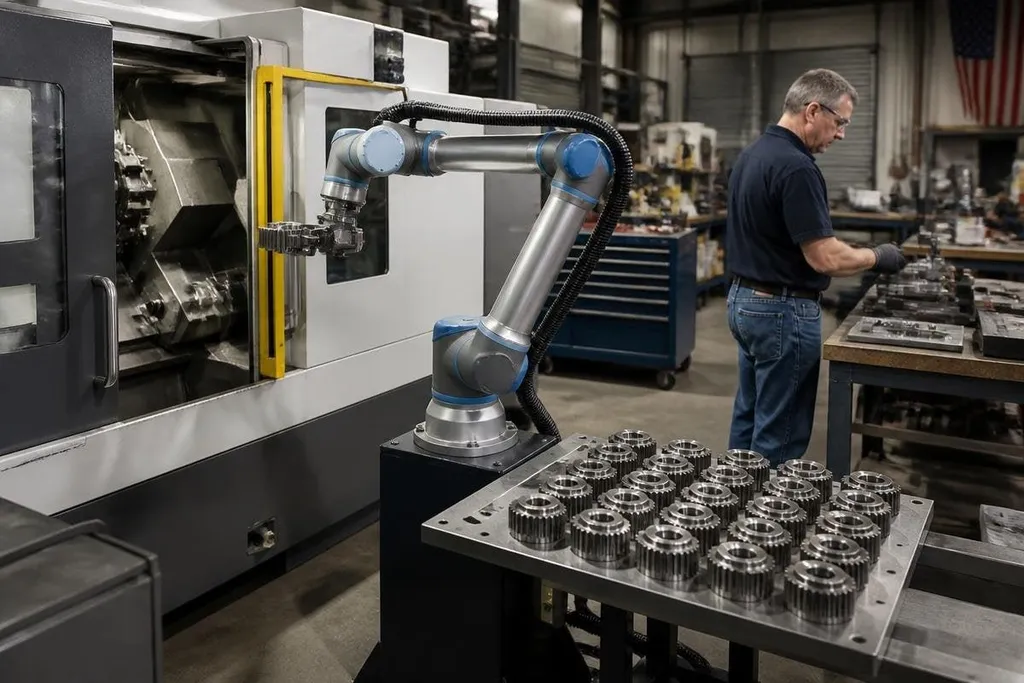
A robot arm does not need to run an entire factory to help a small manufacturer compete. It can load a machine, move finished parts, or check a repeatable feature while people handle work that needs judgment.
The practical question is where a robot can remove a bottleneck without creating a larger maintenance and training burden.
- Start with one repeatable task that slows production.
- Match the robot, gripper, sensors, and safety equipment to that task.
- Measure output, stoppages, quality, and labor time before expanding.
Start with the job, not the robot
Small manufacturers often run short production batches, many product types, or both. That can make a large fixed automation line a poor fit.
One robot cell built around a flexible arm may fit better, especially when the tool and program can change between jobs.
Machine tending is a clear place to look. The robot loads raw material into a CNC machine, waits for the cycle to finish, removes the part, and places it in a set location. A worker can then spend more time on setup, inspection, or jobs that change from part to part.
Palletizing works in a similar way. The robot moves boxes into a set pattern while a worker handles packing, labels, or orders that need a different layout. The task is a good fit when the box size, weight, and handoff point stay within the robot cell's limits.
Inspection can also suit a small shop. A camera checks a hole, edge, label, or surface feature against a stored image or measurement range. That check won't replace a person for every quality decision, but it can catch repeat errors before a batch moves to the next step.
The money comes from steady use
A cell earns its place when it works often enough to remove a real delay. A cell that runs for a short time each week may look useful in a demo and still fail as a business purchase.
The calculation needs more than the robot's purchase price. Include the gripper, fixture, camera, safety scanner, software, installation, training, service, and the floor space that the cell takes. Then compare those costs with the time the task consumes and the cost of missed or late orders.
A small manufacturer should also count changeover time. If a worker needs two hours to reset a cell for every new part, the robot may slow a low-volume job instead of helping it. Quick fixture changes and clear programs matter as much as arm speed.
A two-hour changeover puts the operator back in the cost calculation. Reports at Robot 24 can place a factory robot’s task beside the people who set up the cell and fix faults. That gives a small plant a better test: does the cell cut hands-on work, or move it into programming and maintenance?
People still run the process
The robot needs a person who can load a new program, clear a fault, inspect the first part, and spot a bad handoff. That person doesn't need to write every control routine, but they do need time and training to run the cell safely.
Safety planning starts with the cell layout. A fence, light curtain, safety scanner, or other control may be needed based on the robot, tool, part, and work area. The maker's instructions and local safety rules decide the correct setup.
Maintenance also needs a clear owner. Dust, chips, oil, loose fixtures, and worn gripper fingers can cause missed picks or damaged parts. A daily check of cables, tooling, sensors, and part position can catch small faults before they stop a shift.
The largest limit is often the process around the robot. If parts arrive in mixed positions, the robot may need feeding equipment or vision. If the work changes every few minutes, a person may still do it faster. Automation works best when the task has enough repeatable structure for the system to act on it.
A small-shop decision guide
Use this check before asking for quotes:
- Name the bottleneck: record the task, its cycle time, and how often it delays another operation.
- Check the handoff: confirm where parts arrive, where they go, and how much position variation the robot must handle.
- List the full cell: include the arm, end effector, fixtures, sensors, safety hardware, software, training, and service.
- Test the changeover: run the smallest and largest planned jobs, then record setup time and operator steps.
- Set a review date: compare output, scrap, stoppages, and labor time after the cell has run long enough to expose faults.
I'd start with machine tending or palletizing when the parts and handoff points stay consistent. Those jobs make the work visible, so a small manufacturer can measure the result before adding a second cell.
The next purchase should follow that record, not a robot catalog: one task, one measured result, and one clear reason to add more automation.